
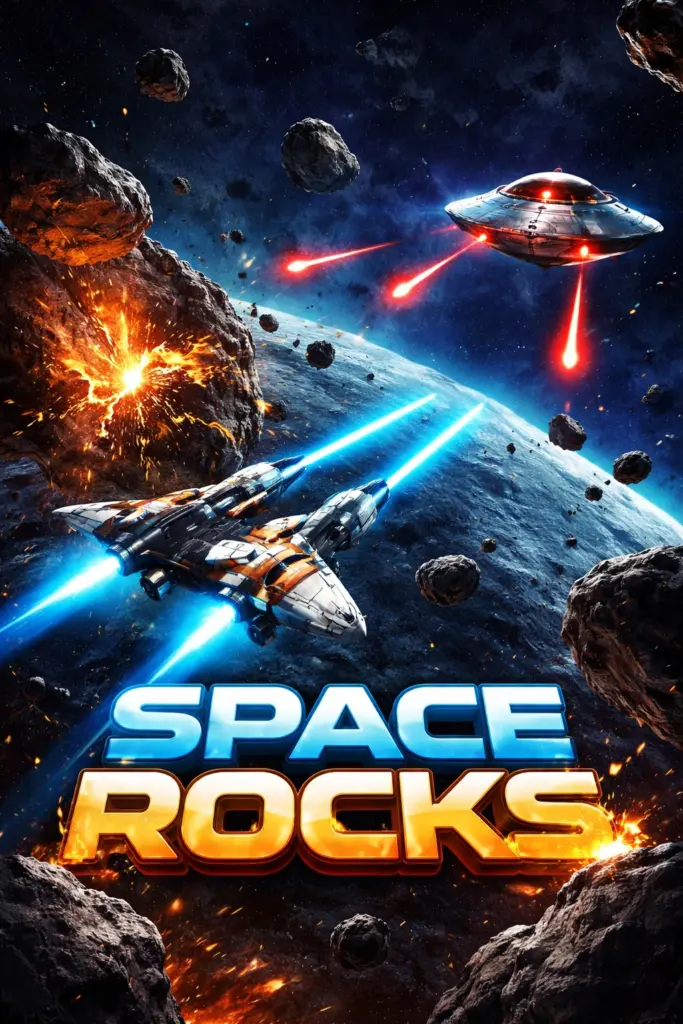
Game story
The Outer Belt used to be quiet—just mining rigs, drifting cargo, and the occasional courier cutting through the dark. Then the rocks started moving wrong.
At first it was small things: a boulder that should’ve coasted harmlessly past a station instead arced inward like it had a mind. A string of near-misses. A few panicked distress calls from prospectors who swore the asteroid field was “herding” them. The corporations blamed faulty nav software. The pilots blamed ghosts.
But you knew better. You’d seen the telemetry.
You’re Jax Kade, a one-ship contractor flying a patched-together interceptor called the Wren—a sleek little hull held together by weld lines, stubbornness, and the kind of luck that runs out without warning. Your job was supposed to be simple: escort a convoy through the debris lanes and keep the scavengers off it. Instead you arrived to find the convoy gone and the lane filled with rocks that shouldn’t be there.
Huge ones. Fresh fractures. Sharp angles like something had snapped them apart on purpose.
Your instruments screamed when you got close. Magnetic interference, unnatural spin rates, micro-bursts of heat. The Wren’s targeting computer tagged them as ordinary asteroids, but the numbers were wrong. Their vectors were too clean. Too deliberate.
Then the first wave hit.
Rocks collided in front of you, split apart, and the smaller pieces fanned out like shrapnel—perfectly spaced to box you in. Your thrusters bit the void, and the Wren drifted sideways, momentum fighting you the way it always does in open space. You fired anyway. Lasers stitched the darkness. One rock popped—then two smaller ones peeled away, faster, meaner, as if the field was learning.
That’s when the Power Crates started showing up: sealed alloy cubes tumbling among the debris, stamped with faded logos from companies that didn’t exist anymore. You scooped one and watched the Wren’s cannons cycle faster than they ever should have. Another lit your cockpit with a low blue ring—shield harmonics. Someone had seeded the lane with old tech, like a dare.
Like a test.
On Wave Three, a signal cut through your comms. Not a voice—just a flat, mechanical ping that crawled across the spectrum. The Wren auto-locked to it, and for a heartbeat, everything went still.
A saucer slid out from behind the rocks.
It wasn’t sleek like the holo-posters. It was industrial—brutal, efficient, and wrong. No transponder. No identification. It moved like it belonged in the field, like the asteroids were making room for it. Your warning alarms didn’t have a label for what it was, only what it did: it fired.
The first shot missed. The second walked toward you. The third would have hit if you hadn’t dumped thrust and spun hard, the Wren skidding like a knife across ice. You returned fire. The saucer jerked. The rocks shifted around it like they were protecting it.
And that’s when your last escort job turned into something else entirely.
Because the deeper you pushed, the clearer the pattern became: the asteroid belt was no longer debris. It was a machine—a moving labyrinth built out of stone and momentum. The saucer wasn’t a raider; it was a shepherd. And behind it, somewhere beyond the dark, was whatever intelligence had decided the Outer Belt needed a gatekeeper.
The miners called it the Belt Mind—an old superstition from the first prospectors. A thing that wakes when you take too much. A thing that throws stones at your ship until you learn humility.
You don’t believe in myths.
But you do believe in vectors.
So you point the Wren into the storm, thumb the hyperspace trigger, and feel the ship tear out of reality—coin-flipping your life for a new position in the void. Maybe it saves you. Maybe it doesn’t. Either way, you’re committed now.
Because if the Belt Mind is real, it’s only getting smarter.
And you’re the only pilot left who’s still flying into it on purpose.